The difference between customer support and customer success has sparked a number of lively discussions. The roles share similar skill sets and goals, but they implement different approaches.
Customer Support teams resolve product-related issues and educate the customer about how the product works. They work with other operational teams like engineering and product to improve existing features while gathering customer feedback for upcoming release cycles.
Customer Success teams, by contrast, proactively work with customers to understand their business goals and help them find success with the product, thereby increasing the lifetime value of the customer.
Both teams have the same goal in mind: to help customers and deliver amazing experiences.
Let’s take a closer look at the definition of both roles and discover how these teams can work together to create value for the customer.
What is Customer Support?
Quality customer support is timely, empathetic help that keeps the customer’s needs at the forefront of every interaction. The definition of customer support continues to evolve as the expectations of today’s customers grow.
Skilled customer support professionals understand the product and care deeply for the customers with whom they interact. They empower customers to find answers (e.g., via self-service), and they report on customers’ challenges to the product team. Chase Clemons, a member of Basecamp’s Customer Support team, sees Customer Support as a feature of the product.
The customer relationship, however, goes beyond SLAs and happiness scores. Customer Success focuses on fostering intimacy by helping customers grow and empowering them to succeed with your product and, by extension, with their own jobs.
What is Customer Success?
The primary focus of Customer Success is to identify what success means to your customer, and to work hand-in-hand to help them achieve it in every aspect of their customer journey with your company.
Help a company's Customer Success team, for example, uses data science analysis to dig deep into how new and existing customers use the product and to jump in when they need help. Depending on the company size and where they’re coming from — another help desk or email — a set of segmentation questions determines the engagement path each customer will take: specific educational emails and other self-service content, one-on-one sessions with a member of the success team, or long-term discussions with an assigned account executive.
Indicators such as whether the customer has interacted with the Customer Support team help determine the current stage of the customer’s journey during the first 90 days since trial sign-up. Based on those indicators, the Success team can jump in to learn more about the customer’s experiences and nudge them toward features that’ll benefit their teams and encourage them to fully use the product.
Customer support vs. customer success
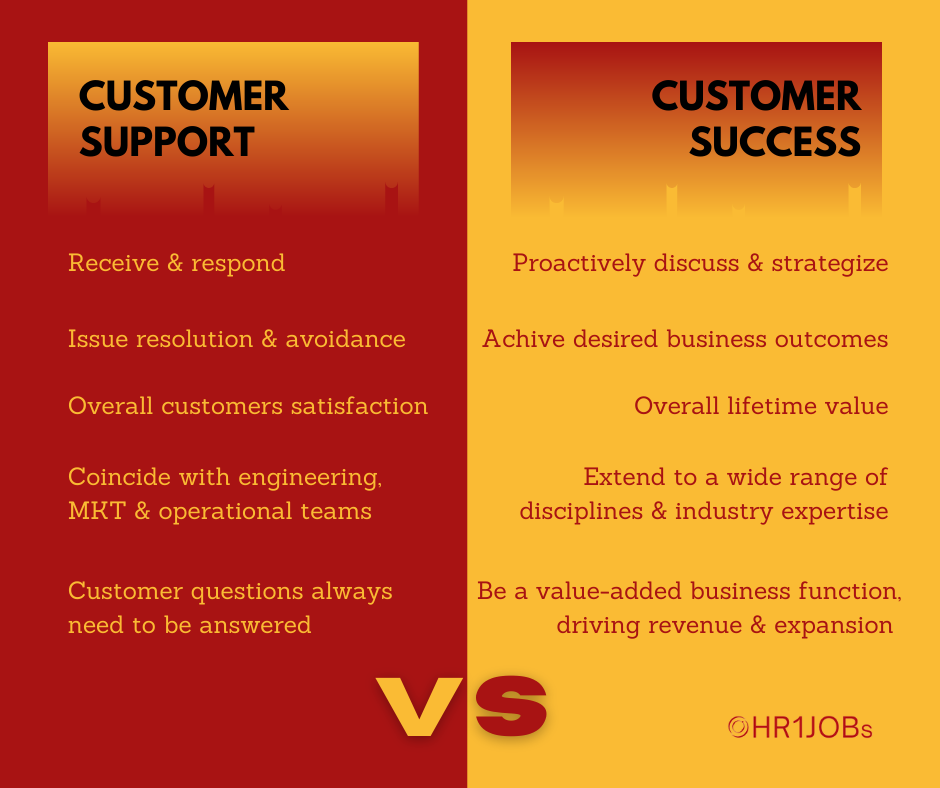
With these definitions, you can already spot a few differentiating qualities between Customer Support and Customer Success. Let’s break it down further in a definitive list:
- Approach: Customer Support receives and responds, while Customer Success proactively discusses and strategizes.
- Objective: Customer Support focuses on issue resolution and avoidance, while Customer Success works to achieve desired business outcomes as the customer journey continues.
- Metrics: Customer Support metrics measure quality of the service provided, resolution times, and overall customer satisfaction; Customer Success focuses on metrics related to business impact like customer retention, expansion, and overall lifetime value.
- Skills and disciplines: Customer Support professionals possess skills that coincide with engineering, marketing, and operational teams; Customer Success can extend to a wide range of disciplines and industry expertise and are more consultative. Both roles require practitioners to be empathetic, resourceful problem solvers with a comprehensive understanding of who the customer is.
- Business impact: Customer Support is integral to running a business because customer questions always need to be answered, while Customer Success is often a value-added business function, driving revenue and expansion.
Customer support & customer success are complementary
While each team assumes specific responsibilities over the customer journey, together they cover all aspects of a great experience with your company. Companies that acknowledge this harmony by grouping Customer Support and Customer Success teams together can create more impact for their customers and the business, as opposed to siloing the two as stand-alone functions or departments.
By uniting Customer Support and Customer Success, your customers feel everyone is on the same team. As you work together to support your customers in their journey to success, you can foster trust and brand loyalty from the first point of contact to the most recent customer conversation.
Source: helpscout.com
HR1Jobs - Multi Industry Online Recruitment Platform
Find jobs and recruitment in IT majors. Discover more at: www.hr1tech.com
 Tiếng Việt
 English